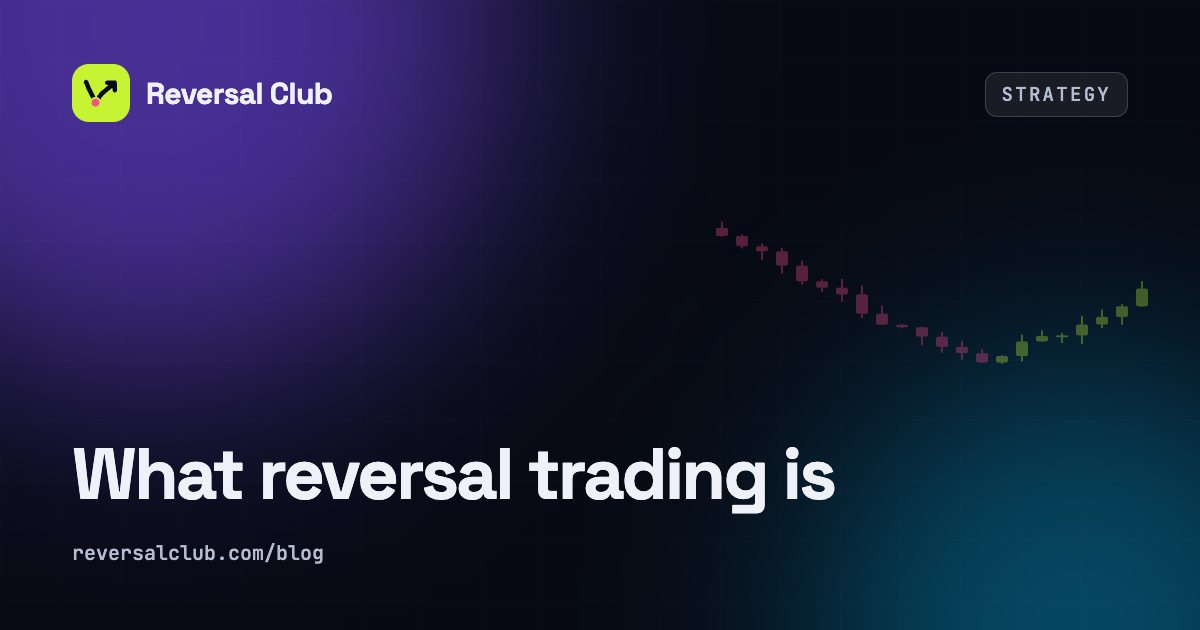
A reversal strategy looks to buy when a price has fallen more than usual in a short time, counting on it to recover part of the drop. It is the opposite of following the trend, which buys what is already rising.
Why prices bounce
After a fast drop, many of those who wanted to sell have already done so, and buyers appear who see the price as cheap. That often causes a bounce, though not always, nor with the same strength.
Following the trend or looking for the reversal
| Style | Trend following | Reversal |
|---|---|---|
| Buy | What is already rising | What has fallen too far |
| The gains | Less frequent, but bigger | More frequent, but smaller |
| The danger | Entering late, when the move is already over | Buying into a fall that does not stop |
The risk: a fall that does not stop
The worst case for a reversal strategy is a fall that does not bounce: the stop loss of one buy is hit, and then the next one too. That is why it needs filters, such as not buying when the whole market is falling hard or waiting for the price to start turning before entering.
What you cannot do without
- A stop loss on every trade, placed right after buying.
- A clear exit: the bounce is usually short, so it pays to take the profit early.
- Protecting your gains: raise the stop loss to break even when the trade goes your way.
- A schedule: in intraday trading, close everything before the end of the session.
An example with numbers
A stock opens at $200 and within twenty minutes falls to $196, 2 % lower, with no news to explain it. It stops making new lows and starts to rise: that is where the buy comes, at $196.50, with the stop loss 0.90 % below, at $194.73. The risk is $1.77 per share.
If the bounce comes and the price returns to $198.50, the trade makes $2 per share, a little over 1 %. If the fall continues, the stop is hit and $1.77 per share is lost. Neither outcome is known in advance: the only thing you control is how much is lost when it goes wrong.
How the turn is spotted
There is no single signal. The usual approach is to combine several clues that point the same way:
- A momentum indicator in its low zone and turning, such as the RSI or the stochastic: the price has fallen fast and the fall is losing strength.
- The distance from a moving average: the further the price moves from its recent average, the more likely it is to come back towards it.
- The price itself: a candle that closes above the previous one after several down candles, or a low that is no longer broken.
- The market as a whole: if the index also stops falling, the bounce has more support.
None of them is always right. That is why the rules are set beforehand and applied the same way on every trade, rather than decided on the fly.
When it works worst
- On strong trend days, when economic data or a news story pushes the whole market in one direction for hours.
- When the fall has a reason: poor earnings, a cut in guidance. There the price has not fallen too far: it is adjusting to new information.
- In low-volume stocks, where a few sellers are enough to keep pushing the price down and the gap between bid and ask is wide.
Common mistakes when trading reversals
- Buying because «it has already fallen a lot», before the price turns. Something being cheap does not stop it getting cheaper.
- Averaging down: buying more when the trade goes against you turns a small loss into a big one.
- Moving the stop loss further away or removing it «to give it room». The stop is what limits the damage when the bounce does not come.
- Expecting it to return to the earlier price: the bounce usually recovers only part of the fall.
- Trading too large: losses can come in a row, so each one has to be small. See how to calculate position size.
Why intraday
You can look for reversals on any timeframe, but within the day there is one advantage: everything is closed before the end of the session, so news published overnight does not catch you with an open position. In exchange, the moves are small and costs weigh more: commissions, the bid-ask difference and slippage eat a bigger share of each trade. That is why it is usually done in large, heavily traded stocks and during the busiest hours. If you receive the trades as alerts, first read what a trading signal should include.
At Reversal Club, the signals follow an intraday reversal strategy on large NASDAQ stocks. Every buy comes with its stop loss, we tell you when to raise it to break even and when to close, and nothing stays open overnight. The rules are in the methodology, and you can work out your stop loss and your shares with the calculator.
This is general information, not financial advice. Trading on the stock market carries a high risk of losing money.